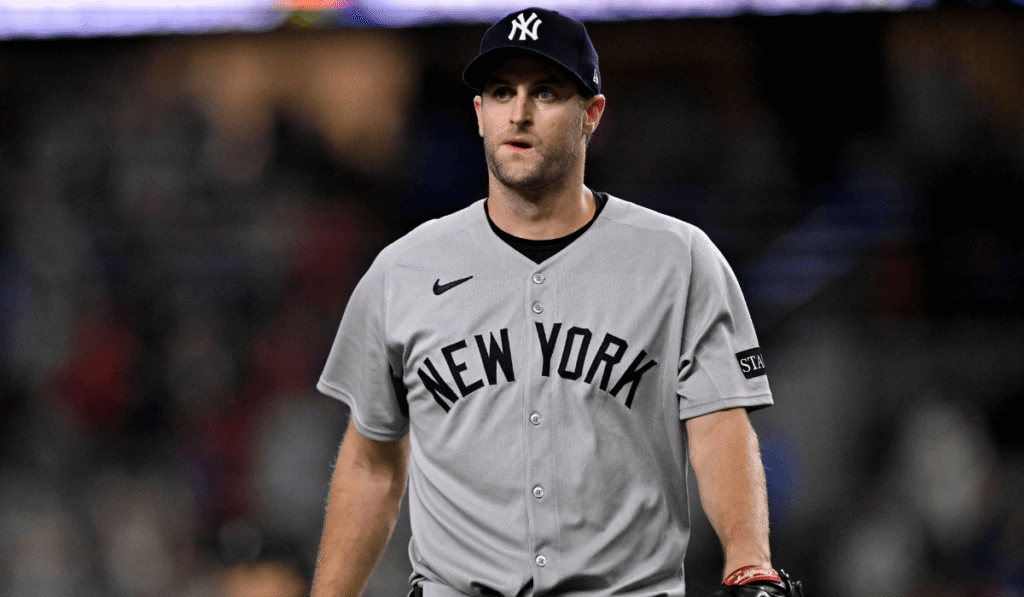
The Yankees just locked in a bullpen wildcard for less than $1 million while other teams are spending millions—and most fans have no idea what’s coming. Jake Bird’s redemption arc might be the steal of the offseason, but only if you know what the front office sees that everyone else missed.
Quick Snapshot: Jake Bird by the Numbers
Personal Info
- Full Name: Jacob Timothy “Jake” Bird
- Age: 30 years old (Born: December 4, 1995)
- Birthplace: Newhall, California
- Height: 6’3″ (1.91 m)
- Weight: ~200 lbs (90 kg)
- Position: Right-handed Relief Pitcher (RHP)
- Bats/Throws: R/R
Team Info
- Current Team: New York Yankees
- Jersey Number: #59
- Acquired: July 31, 2025 (from Colorado Rockies)
2025 Season Stats (Combined)
- Record: 4-2
- ERA: 5.53
- Innings Pitched: 55.1 IP
- Strikeouts: 66 K
- Walks: 25 BB
- WHIP: 1.54
- Games Appeared: 48
Contract Details (2026)
- Salary: $975,000 (avoided arbitration January 9, 2026)
- Contract Type: One-year deal
- Service Time: 3.051 years
- Status: Pre-free agency
The Jake Bird Trade That Nobody Saw Coming
When the Jake Bird trade went down on July 31, 2025, it barely registered on most radar screens. The Yankees were hunting for bullpen help at the deadline, and general manager Brian Cashman pulled the trigger on acquiring the right-hander from the Colorado Rockies.
In exchange for Bird, the Yankees sent two prospects to Colorado: second baseman Roc Riggio and left-handed pitcher Ben Shields. At the time, it looked like a low-risk depth move—the kind of trade that gets buried in the deadline news cycle.
But here’s what makes this fascinating: the Yankees didn’t give up on Bird as everyone assumed. While fans forgot about him after he was optioned to Triple-A following three rough outings, the organization has been quietly crafting a master plan.
Why the Yankees Made the Move
The front office targeted Bird’s sinker profile specifically. At his best, Bird generates ground balls at an elite rate with a heavy, tailing sinker that sits 94-95 mph. The Yankees’ analytics department saw something salvageable—a pitcher whose stuff could thrive with the right adjustments and a healthy offseason.
Bird came to New York after posting a 4.73 Jake Bird era with the Rockies (before the trade), striking out 66 batters in 55 innings. His time pitching half his games at Coors Field—one of baseball’s most hitter-friendly parks—inflated his numbers. The Yankees bet that removing that factor could help unlock his potential.
Breaking Down Jake Bird Yankees Stats
The Jake Bird stats from 2025 tell a story of extreme volatility—a reliever who flashed brilliance but couldn’t maintain consistency.
With Colorado (Before July 31)
- 45 appearances
- 4-1 record
- 4.73 ERA
- 53.1 innings pitched
- 56 strikeouts (excellent K rate)
- Started the season on fire: threw 5 scoreless innings to open the year
With New York (After Trade)
- 3 appearances
- 2.0 innings pitched
- 27.00 ERA (6 earned runs allowed)
- Notable disasters: Gave up a grand slam to Kyle Stowers in his Yankees debut; surrendered a walk-off three-run homer to Josh Jung
Bird’s Yankees debut was catastrophic. Within five days of arriving, he was optioned to Triple-A Scranton/Wilkes-Barre, where he spent the rest of 2025. Combined between both teams, his full 2025 season produced a 5.53 ERA across 55.1 innings with 66 strikeouts.
The Hidden Positives in the Numbers
Despite the inflated ERA, Bird showed:
- 10.7 K/9 (strikeouts per nine innings)—excellent for a reliever
- High ground ball rate when his sinker command was sharp
- Strong velocity on his fastball arsenal (95+ mph sinker)
- Durability: 48 appearances showed he could handle a heavy workload
The problem wasn’t his stuff—it was execution and pitch selection.
What’s Jake Bird’s 2026 Contract Worth?
The Jake Bird contract for 2026 came together on January 9, 2026, when both sides avoided arbitration. Bird signed a one-year deal worth $975,000—an absolute bargain in today’s market, where middle relievers regularly command $3-5 million annually.
How the Contract Works
Bird was arbitration-eligible for the first time this offseason with 3.051 years of service time. Rather than go through the arbitration hearing process (which can get contentious), the Yankees and Bird’s representatives agreed to terms on a deal that gives him a modest raise from his 2025 pre-arbitration salary of $770,000.
For context, the Yankees paid:
- $9 million to David Bednar (closer)
- $6.1 million to Camilo Doval
- $975,000 to Jake Bird
If Bird can deliver even replacement-level performance, it’s one of the most cost-efficient contracts on the Yankees’ 2026 roster.
The Yankees’ Secret Weapon: Retooling Bird’s Arsenal
Here’s where things get interesting. According to recent reports, the Yankees haven’t given up on Bird—far from it. The organization has been working with him this offseason on a comprehensive pitch mix overhaul.
What’s Changing?
The Problem in 2025: Bird overused his sweeper (a type of slider with more horizontal movement). Opponents hit .257 with a .457 slugging percentage against it. The pitch caught too much of the plate and got crushed.
The 2026 Plan: Simplify the attack.
- Prioritize the sinker low in the zone to get ahead in counts
- Use the slider aggressively as an out-pitch off the plate
- Reduce sweeper usage or refine its location
- Let the heavy sinker generate weak contact and double-play grounders
Why It Could Work
Bird’s sinker has elite characteristics:
- 94–95 mph average velocity (above MLB average for relievers)
- Significant arm-side run (tails away from righties, in on lefties)
- Low release point (sidearm delivery creates a difficult angle for hitters)
When Bird locates this pitch at the knees, it’s nearly unhittable. The Yankees’ pitching development staff, led by highly-regarded pitching coach Matt Blake, has a track record of fixing underperforming pitchers. Blake helped resurrect careers for guys like Clay Holmes and Luke Weaver.
FanGraphs projects Bird to post a sub-4.00 ERA in 2026 if the adjustments take hold. That would make him a high-leverage bridge option between the middle innings and the back-end relievers.
Who Is Jake Bird? The Journey to the Bronx
College Star at UCLA
Bird attended UCLA, where he became one of the Pac-12’s best pitchers. As a senior in 2018, he posted a 2.18 ERA, leading the conference, striking out 61 batters over 111.2 innings. He earned All-Pac-12 honors and Academic All-America recognition—a cerebral player who understands the game.
“I’m just trying to pitch contact,” Bird said during his college days. “My stuff is pretty heavy, which gets a lot of ground balls. Just let the defense do their thing.”
That mentality is exactly what the Yankees love: a pitcher who trusts his defense and induces weak contact.
Draft and Minor League Development
The Colorado Rockies selected Bird in the 5th round of the 2018 MLB Draft (156th overall) out of UCLA. He signed for a $50,000 bonus and climbed steadily through the minors:
- 2019: Named South Atlantic League All-Star with Single-A Asheville
- 2021: Dominated Double-A and Triple-A with a 3.38 ERA and 70.9% ground ball rate
- 2022: Made MLB debut on June 16 vs. Cleveland Guardians
MLB Career Highlights
2023 – Breakout Season:
- Posted 0.9 WAR (Wins Above Replacement)
- 89.1 innings over 70 appearances (heavy workload)
- Established himself as a reliable Rockies bullpen arm
2024 – Injury-Plagued Year:
- Dealt with elbow inflammation and groin injury
- Multiple stints on the injured list
- 4.50 ERA in limited action
2025 – Roller Coaster:
- Started strong with 5 scoreless innings
- Inconsistent middle stretch
- Traded to the Yankees at the deadline
- Struggled in limited MLB time with NYY
The Physical Profile: How Bird’s Body Helps His Game
At 6’3″ and 200 pounds, Bird has an ideal pitcher’s frame—tall with room to add strength without sacrificing flexibility. His height allows him to create a steep downward angle on his pitches, especially devastating with his low arm slot.
The Sidearm Advantage
Bird’s low three-quarters to sidearm delivery is rare among MLB pitchers. This unconventional angle creates several advantages:
- Difficult timing for hitters adjusting to the release point
- Enhanced movement on his sinker due to the arm angle
- Platoon resistance against right-handed hitters (they see the ball coming from an unusual angle)
However, the sidearm slot can also lead to command issues if mechanics drift even slightly. That’s why the Yankees’ focus on simplifying his pitch selection is so important.
Bird’s Personal Life: More Than Just Stats
Jake Bird identifies as Jewish (his paternal grandmother was Jewish) and grew up in Valencia, California. He’s the second of four brothers and has dreamed of playing in the majors since childhood. At eight years old, he signed friends’ yearbooks with “Save this autograph for when I’m playing in the major leagues”—a prophecy that came true.
Bird is known for his intelligence and work ethic. As an economics major at UCLA, he balanced academics with athletics and earned Academic All-America honors. This intellectual approach to baseball shows in how he discusses pitch sequencing and game situations.
No Public Information on Wife or Family
As of January 2026, there is no publicly available verified information about Jake Bird being married or having a wife. The 30-year-old keeps his personal life private, with most coverage focusing on his professional career.
2026 Outlook: Could Bird Be the Yankees’ Hidden Gem?
The Yankees enter 2026 with a revamped bullpen after their 2025 struggles (the pen posted a 4.37 ERA). They’ve invested heavily in closers David Bednar ($9M) and Camilo Doval ($6.1M), but they need quality middle-inning arms.
That’s where Bird comes in.
Best-Case Scenario
- Refined sinker command produces 60%+ ground ball rate
- Slider/slider combo becomes an effective 1-2 punch
- Bird emerges as a multi-inning, high-leverage option
- Posts a 3.50-3.80 ERA over 60+ innings
Worst-Case Scenario
- Command issues persist
- Continues to get hit hard on elevated pitches
- Shuttles between Triple-A and MLB as organizational depth
Most Likely Scenario
- Solid middle relief option (4.00-4.50 ERA)
- Fills 6th/7th inning role
- Provides 50-60 innings of serviceable work
Even if Bird just provides league-average relief at $975K, that’s tremendous value. The Yankees can afford to be patient, given the minimal financial risk.
Frequently Asked Questions About Jake Bird
1. Was Jake Bird really traded to the Yankees?
Yes, Jake Bird was traded to the New York Yankees from the Colorado Rockies on July 31, 2025. The Yankees sent prospects Roc Riggio (a second baseman) and Ben Shields (a left-handed pitcher) to Colorado in exchange for Bird. This was part of the Yankees’ trade deadline bullpen reinforcement strategy.
2. What are Jake Bird’s stats with the Yankees?
Bird’s 2025 numbers with the Yankees were rough: he appeared in just 3 games, pitched 2.0 innings, and posted a 27.00 ERA after allowing 6 earned runs. He was quickly optioned to Triple-A. His full 2025 season (combining time with Colorado and New York) produced a 4-2 record, 5.53 ERA, 66 strikeouts, and 1.54 WHIP over 55.1 innings across 48 appearances.
3. How much is Jake Bird making in 2026?
Jake Bird signed a one-year contract worth $975,000 with the Yankees for 2026 after avoiding arbitration on January 9, 2026. This is a modest salary for an MLB reliever, making him one of the most affordable arms in the Yankees’ bullpen.
4. What is Jake Bird’s role—is he a starter or reliever?
Jake Bird is exclusively a relief pitcher. He has been used out of the bullpen since his MLB debut in 2022 and is not a starting pitcher. The Yankees plan to use him in middle relief or possibly high-leverage situations if he performs well in 2026.
5. What is Jake Bird’s best pitch, and how fast does he throw?
Bird’s primary weapon is his heavy sinker, which averages 95-96 mph and features significant arm-side tailing action. He throws it from a low, sidearm slot that creates a difficult angle for hitters. He also uses a slider, sweeper, cutter, changeup, and curveball. His sinker is designed to generate ground balls and weak contact when located properly.
6. Why did the Yankees option Jake Bird to Triple-A after trading for him?
Bird struggled dramatically in his first three appearances with the Yankees after the 2025 trade deadline. He gave up 6 earned runs in just 2 innings, including a grand slam in his debut and a walk-off homer in another game. The Yankees sent him to Triple-A Scranton/Wilkes-Barre to work on his mechanics and pitch execution. However, the organization hasn’t given up on him—they’re retooling his pitch mix this offseason with plans for him to contribute in 2026.
The Bottom Line: Don’t Sleep on Jake Bird in 2026
While Yankees fans are focused on the big-money acquisitions and established stars, Jake Bird could be the under-the-radar pickup that makes a difference. At just $975,000, he represents one of the lowest-risk, highest-upside bets in the bullpen.
The Jake Bird era in 2025 was forgettable, but the Yankees’ player development staff sees untapped potential. With a simplified approach, emphasis on his best pitch (the sinker), and a full offseason to reset, Bird has the tools to succeed.
Will he be the next Yankees reclamation project success story? Or will he fade into organizational depth? Spring training will tell the story—but smart fans are keeping Jake Bird on their radar in 2026.
The Yankees are betting $975K that Bird can fly higher than anyone expects. And with their track record of fixing broken relievers, that bet just might pay off.

Vikas Tiwari, writer and editor focused on Yankees news, rumors, trade updates, and game coverage, emphasizing accuracy, sourcing, and clarity.