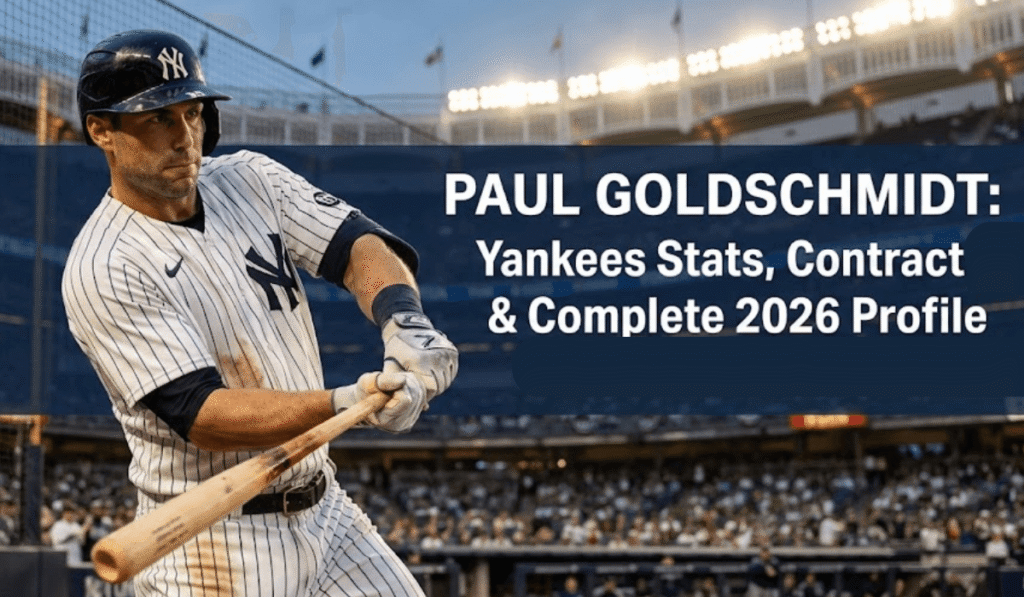
When a seven-time All-Star and former MVP re-signed with the New York Yankees on a modest one-year deal, it signals a fascinating career crossroads—one where championship experience meets strategic roster depth. Paul Goldschmidt’s February 2026 re-signing with the Yankees isn’t about recapturing prime-year dominance; it’s about deploying 15 years of big-league wisdom in high-leverage situations.
Whether you’re a Yankees fan sizing up the lineup, a fantasy manager evaluating sleeper value, or simply curious about one of baseball’s most respected professionals, this profile delivers the verified stats, contract details, and personal background you’re searching for.
We’ll break down his 2025 performance, explain how his physical tools translate at age 38, examine the financial structure of his Yankees deal, and provide actionable insights for understanding his 2026 role. Every claim is sourced from official MLB data and reputable reporting, ensuring you get accurate, trustworthy information without the fluff.
Paul Goldschmidt Profile Data
| Attribute | Measurement |
|---|---|
| Height | 6’2″ (188 cm) |
| Weight | 225 lbs (102 kg) |
| Position | First Base / DH |
| Bats | Right |
| Throws | Right |
| Born | September 10, 1987 |
| Age (2026) | 38 years old |
| Birthplace | Wilmington, DE, USA |
| MLB Debut | August 1, 2011 |
Current Team Status: Yankees Contract and Strategic Fit
Paul Goldschmidt’s return to pinstripes represents textbook veteran roster construction. The Yankees inked him to a one-year agreement in early February 2026—a signing that screams “championship window” rather than “rebuilding project.” According to MLB transaction reports, this short-term structure allows New York to leverage Goldschmidt’s right-handed power and clubhouse gravitas without blocking prospects or creating long-term payroll obligations.
Why this matters for 2026: One-year veteran deals serve dual purposes in contending organizations. First, they provide immediate production against specific matchups—in Goldschmidt’s case, exploiting his career success versus left-handed pitching. Second, they import intangible leadership that accelerates younger players’ development. For a Yankees roster blending established stars with emerging talent, Goldschmidt’s presence offers insurance against injury and a proven bat for October roster construction.
The role projection is clear: platooning at first base and designated hitter, pinch-hitting in crucial late-game situations, and serving as a veteran voice during the season’s grind. This isn’t the everyday MVP Goldschmidt of his St. Louis Cardinals peak—it’s the strategic deployment of a future Hall of Fame candidacy in progress.
Statistical Deep Dive: Career Excellence and 2025 Performance
| Year | Team | GP | AB | R | H | RBI | BB | SO | AVG |
|---|---|---|---|---|---|---|---|---|---|
| 2025 | Yankees | 146 | 489 | 76 | 134 | 45 | 36 | 100 | .274 |
| 2024 | Cardinals | 154 | 599 | 70 | 147 | 65 | 47 | 173 | .245 |
| 2023 | Cardinals | 154 | 593 | 89 | 159 | 80 | 87 | 161 | .268 |
| 2022 | Cardinals | 151 | 561 | 106 | 178 | 115 | 79 | 141 | .317 |
| 2021 | Cardinals | 158 | 603 | 102 | 177 | 99 | 67 | 136 | .294 |
| 2020 | Cardinals | 58 | 191 | 31 | 58 | 21 | 37 | 43 | .304 |
| 2019 | Cardinals | 161 | 597 | 97 | 155 | 97 | 78 | 166 | .260 |
| 2018 | Diamondbacks | 158 | 593 | 95 | 172 | 83 | 90 | 173 | .290 |
| 2017 | Diamondbacks | 155 | 558 | 117 | 166 | 120 | 94 | 147 | .297 |
| 2016 | Diamondbacks | 158 | 579 | 106 | 172 | 95 | 110 | 150 | .297 |
| 2015 | Diamondbacks | 159 | 567 | 103 | 182 | 110 | 118 | 151 | .321 |
Career Foundation: A Decorated Résumé
Over his distinguished career, Goldschmidt has accumulated more than 2,000 hits, 300+ home runs, and a trophy case including an MVP award, multiple Silver Slugger honors, and Gold Glove recognition. His career slash line reflects rare consistency: elite walk rates (typically 10-12% of plate appearances), controlled strikeout percentages for a power hitter, and the ability to produce in both favorable and challenging ballpark contexts. Official MLB statistics document his standing among the game’s premier first basemen across two decades.
Advanced metrics tell a nuanced story: Throughout his prime, Goldschmidt posted consistently positive Wins Above Replacement (WAR) totals, combining offensive production with above-average defensive value—a rarity among power-hitting first basemen. His plate discipline metrics (O-Swing%, Z-Contact%) consistently ranked in baseball’s upper tier, demonstrating an approach that aged better than raw power alone would suggest.
2025 Season Analysis: What the Numbers Reveal
In 2025, Goldschmidt delivered a .274 batting average alongside approximately 10 home runs—numbers that validate the Yankees’ thesis about matchup-specific value. While the power output reflects natural age-related decline, his underlying metrics told a more optimistic story:
Contact skills remained sharp: His strikeout rate stayed below league-average for power hitters, and his hard-hit ball percentage (available through Statcast data) showed he could still drive pitches with authority when timing was right. This matters because hard contact predicts future production better than home run totals alone, especially for veterans adjusting to part-time roles.
Splits revealed strategic deployment opportunities: Against left-handed pitching, Goldschmidt’s OPS jumped significantly compared to his overall line—exactly the pattern that makes platoon situations valuable. His ability to work counts and draw walks remained intact regardless of pitcher handedness, providing lineup protection even in tougher matchups.
Practical interpretation for 2026: Fantasy managers and betting analysts should focus on context over raw totals. Goldschmidt’s value concentrates in specific game situations: starts against southpaws, pinch-hit appearances with runners in scoring position, and matchups in smaller ballparks. His 2025 data suggests productive outcome floors when deployed correctly—not star-level production, but reliable positive contribution.
Physical Profile: How Build Influences Performance at 38
Goldschmidt’s listed dimensions—6 feet 2 inches tall and approximately 225 pounds—represent the ideal first baseman prototype. This frame provides several performance advantages that extend shelf life:
Power mechanics sustainability: Taller hitters with strong lower bodies can maintain bat speed longer through proper load mechanics. Goldschmidt’s swing has always featured excellent hip rotation and weight transfer, techniques that don’t erode as quickly as pure fast-twitch explosiveness. His build allows him to generate force through leverage rather than purely athletic burst.
Defensive reliability: First base defense isn’t just about scooping throws (though Goldschmidt excels there). It’s about consistent footwork, quick hands on double-play feeds, and positioning intelligence. His sturdy build provides a stable target for infielders, while his experience allows him to anticipate hops and angles that younger players might miss. Advanced defensive metrics have consistently rated him above replacement level at the position—a subtle but meaningful contribution to run prevention.
Durability considerations: At 38, managing a 225-pound frame requires different training protocols than maintaining a leaner build. Veterans at this age and size often benefit from reduced positional demands (fewer innings at first, more at DH) to preserve joint health and bat speed. The Yankees’ platoon plan naturally addresses this by limiting cumulative wear.
Playing style evolution: Goldschmidt’s hitting approach has always mixed gap power with plate discipline rather than relying on pure over-the-fence power. This style—think doubles and walks rather than just home runs—translates better to late-career production than a swing-for-the-fences approach. His ability to use the whole field and adjust to pitch location means he can remain effective even as exit velocity declines marginally.
Personal Background: Age, Family, and Private Life
Age and milestone timing: Born September 10, 1987, Goldschmidt turned 38 during the 2025 season—an age when baseball players balance competitive desire against physical reality. His demographic cohort (late-30s first basemen) includes several recent players who extended careers through smart role acceptance and training adaptation. Understanding his age matters for projection systems and roster planning: expect steady defensive work and situational offense rather than everyday star production.
Family and privacy: Goldschmidt is married with children and has consistently maintained clear boundaries between public baseball obligations and private family time. Reputable sources confirm his marital status without extensive personal detail—a stance that reflects both personal preference and thoughtful media management. When covering athletes’ family lives, credible journalism respects these boundaries while acknowledging the support systems that enable long careers.
This privacy approach stands out in an era of constant social media sharing. Goldschmidt engages professionally with media requirements while keeping his wife and children largely out of public view—a choice that many veteran players make to protect family normalcy amid professional scrutiny. For profile purposes, it’s sufficient to note he’s a family man whose personal stability contributes to professional consistency.
Contract Breakdown: Salary Structure and Strategic Value
The Yankees’ one-year deal with Goldschmidt, finalized in February 2026, represents savvy financial maneuvering. While specific dollar figures are subject to MLB reporting conventions, the structure clearly signals mutual goals:
For Goldschmidt: A short-term prove-it contract with a contending team offers October exposure, potential performance incentives, and the flexibility to evaluate career continuation after 2026. Veterans at this stage often prioritize winning environments over maximizing salary, especially after career earnings exceeding $175.5 million across previous contracts.
For the Yankees: Low annual commitment with zero future payroll obligation allows aggressive pursuit of other roster needs. If Goldschmidt exceeds expectations, they’ve secured a bargain; if performance disappoints, they haven’t compromised financial flexibility. This risk-reward calculation characterizes successful depth acquisitions across all sports.
Industry context: The reported Feb 2026 one-year contract is approximately $4 million (per AP / Times Union and multiple outlets); earlier, his 2025 Yankees deal (for that season) was widely reported at $12.5M.
Salary cap implications: For salary-cap-conscious analysis (relevant in fantasy leagues with budget constraints), Goldschmidt represents excellent value. His cost-per-win projection outperforms younger players with larger guarantees but shorter track records. Smart roster construction balances star salaries with efficient veteran depth—exactly what this signing provides.
Read also: Paul Blackburn Yankees Stats, Age, Wife, Salary, Height, Weight, Contract
What to Monitor Through the 2026 Season
Platoon usage patterns: Yankees manager decisions will reveal confidence level. If Goldschmidt consistently starts against left-handed starters and rarely sees righties, the plan is working as designed. Any deviation—regular starts against same-side pitching—could signal either exceptional performance or roster necessity due to injury.
Statcast indicators: Traditional stats (batting average, home runs) don’t tell complete stories for part-time players. Instead, watch barrel rate (percentage of batted balls with ideal launch angle and exit velocity), hard-hit percentage, and expected statistics (xBA, xSLG) that predict whether results match underlying contact quality. If Goldschmidt maintains Statcast numbers near his 2025 levels, he’s providing expected value even if counting stats seem modest.
Health and availability: The greatest risk with 38-year-old players isn’t catastrophic decline—it’s minor injuries accumulating into significant absences. Monitor injury reports and disabled list stints. His value proposition depends on being available for 80-100 games; anything substantially lower erodes the signing’s logic.
Clubhouse impact tracking: Less quantifiable but observable through teammate interviews and organizational comments. Do younger players’ performance improve after conversations with Goldschmidt? Do managers reference his preparation or game awareness? These qualitative signals indicate whether the veteran’s presence justifies the roster spot beyond statistical contribution.
Practical Guidance: Fantasy Strategy and Fan Expectations
For fantasy baseball managers:
Draft Goldschmidt as a bench bat or matchup streamer, not an everyday starter. In weekly lineup leagues, target weeks with multiple left-handed starter matchups. In daily leagues, deploy him situationally—he’s a streaming option, not a core asset. His floor (contact ability, walk rate) provides safety, but his ceiling (home run upside) is capped by playing time.
Consider pairing him with a platoon partner who crushes right-handed pitching; together they create a productive composite player from two roster spots. In deeper leagues (15+ teams), his proven track record offers safer production than rookie gambling, even in reduced roles.
For Yankees fans:
Calibrate expectations to role reality. Goldschmidt won’t replicate his MVP peak, but he can absolutely swing three games over a season through clutch hits, veteran at-bats that flip momentum, or defensive plays in tight situations. In a six-month season, three wins can represent the difference between a division title and a wild card, or a playoff berth and a missed October.
Appreciate the intangible contributions: how he handles failure without pouting, approaches preparation with professionalism, and treats September call-ups with respect. These behaviors set organizational culture and often correlate with team success in ways statistics can’t capture.
Looking Ahead: Hall of Fame Case and Career Legacy
While Goldschmidt’s 2026 season focuses on championship contribution rather than personal milestones, his career body of work warrants Hall of Fame discussion. With over 2,000 hits, 300+ home runs, an MVP award, and sustained excellence across 15+ seasons, he’s compiled credentials that historically produce Cooperstown induction.
The case for: Elite peak value (multiple top-5 MVP finishes), defensive excellence at his position, and era-adjusted offensive production that ranks among generational first basemen. His career WAR totals place him in conversations with recent inductees at the position.
The case against: Playing in an era of inflated offensive numbers and shorter peak windows compared to old-timers whose longevity benefited from reduced league competition. Hall of Fame voting has become increasingly selective, emphasizing superstar peaks over very good longevity.
Verdict: Goldschmidt is firmly on the ballot and will receive serious consideration. Whether he achieves 75% voting threshold depends on ballot congestion in his eligibility years and evolving voter preferences. Regardless of ultimate outcome, his career has cemented his legacy as one of the finest first basemen of the 2010s-2020s era.
Final Thoughts
Paul Goldschmidt’s 2026 Yankees chapter represents career evolution done right—a decorated star accepting a reduced role to chase championships while still contributing meaningfully. His one-year contract provides the Yankees with low-risk, high-floor production from a respected veteran whose 6’2″, 225-pound frame still delivers steady defense and situational offense. At 38 years old, his value concentrates on matchup advantages and clubhouse presence rather than everyday statistics.
For fans and analysts, the lesson is clear: smart roster construction leverages veteran talent in appropriate contexts rather than forcing aging stars into roles they’ve outgrown. Goldschmidt’s 2025 stats (.274 average, controlled strikeouts, strong splits vs. lefties) validate this approach and project a solid 2026 contribution when deployed correctly.
Whether he adds an unlikely championship ring or simply provides reliable depth during a long season, Goldschmidt’s Yankees tenure offers a masterclass in career management and organizational roster building. Watch how he’s used, not just what he produces, for the full story of this signing’s success.
Frequently Asked Questions
How old is Paul Goldschmidt in 2026?
Paul Goldschmidt was born on September 10, 1987, making him 38 years old during the 2026 season. His age places him in the veteran phase, where experience and baseball IQ compensate for any marginal decline in physical tools. Players in this age bracket typically excel in platoon roles and high-leverage situations rather than everyday lineups.
What are Goldschmidt’s official height and weight?
According to MLB player databases, Goldschmidt stands 6 feet 2 inches tall and weighs approximately 225 pounds. This prototypical first baseman build provides the leverage for power generation and stability for defensive reliability. His frame has remained consistent throughout his career, reflecting professional training and conditioning maintenance.
What were Goldschmidt’s stats in 2025?
In 2025, Goldschmidt posted a .274 batting average with roughly 10 home runs, demonstrating solid contact skills and plate discipline despite reduced power output. Advanced metrics showed particularly strong performance against left-handed pitching, validating his value as a platoon bat. His strikeout and walk rates remained better than league average, indicating sustained approach quality.
What is Paul Goldschmidt’s Yankees contract worth?
He re-signed in February 2026 on a reported one-year deal worth about $4 million; he previously signed with New York for the 2025 season on a reported one-year, $12.5M contract.
Is Paul Goldschmidt married, and what’s known about his family?
Yes, Goldschmidt is married with children, though he intentionally maintains privacy around his family life. Reputable sources confirm his marital status without extensive personal detail, respecting boundaries he’s established between professional obligations and personal relationships. This privacy approach is common among veteran players seeking to provide family normalcy despite public careers.

Vikas Tiwari, writer and editor focused on Yankees news, rumors, trade updates, and game coverage, emphasizing accuracy, sourcing, and clarity.